Change-point detection with a Rust core
Fast, memory-aware offline change-point detection for Python. Rustures combines
familiar fit / predict APIs with exact dynamic programming, kernel methods,
robust costs, and endpoint-batched custom Python costs.
Alpha software
Rustures is usable and extensively tested, but its public API and compatibility guarantees may still change between releases. Pin the version in production and validate results on representative data.
A small Python API, a native execution core
import rustures as rpt

signal, truth = rpt.pw_constant(
    n_samples=600,
    n_features=2,
    n_bkps=3,
    noise_std=0.7,
    seed=42,
)

prediction = rpt.Pelt(
    model="l2",
    min_size=10,
    jump=1,
).fit_predict(signal, pen=12.0)

precision, recall = rpt.precision_recall(truth, prediction, margin=10)
print(prediction, precision, recall)
Rustures uses half-open segments. A result of [120, 360, 600] means the three
segments [0, 120), [120, 360), and [360, 600). The terminal sample count is
always included in the returned breakpoint list.
See the detectors work
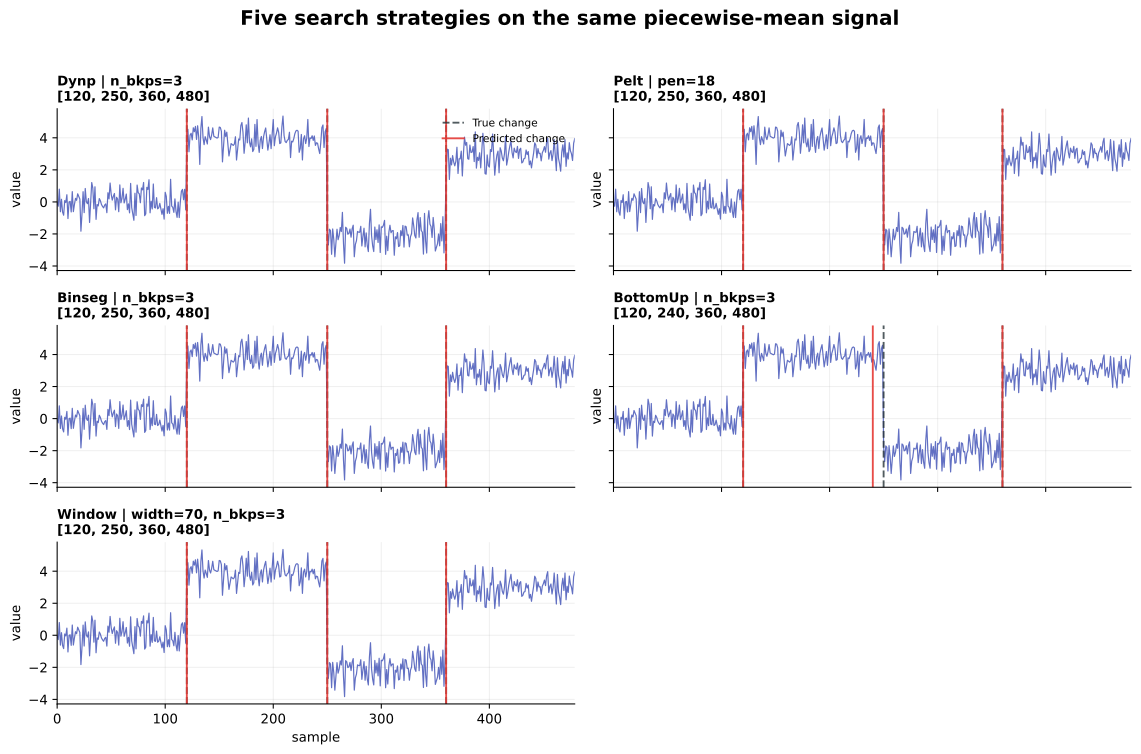
The dashed lines are the known changes and the red lines are Rustures predictions. The visual tutorials show the exact outputs, runnable code, kernel comparisons, and a robust example with injected outliers.
7 detectors Exact, penalized, kernel, greedy, and L1-Potts search.
8 cost models Mean, median, rank, Gaussian, regression, AR, trend, and metric scatter.
3 kernels Linear, RBF, and cosine with three exact storage backends.
Python 3.10+ Stable-ABI wheels for supported desktop and Linux targets.
Why Rustures?
Native hot paths
Built-in costs and search algorithms execute in optimized Rust. Long native predictions release the Python GIL after Rustures has taken ownership of the state needed for safe execution.
Explicit memory policy
Dynp estimates its prediction workspace before allocation. Full-Gram kernel search also has a configurable memory limit, while fused and streaming backends avoid mandatory quadratic Gram storage.
Exact kernel choices without one fixed storage strategy
Choose linear, RBF, or cosine kernels. The default fused backend is designed for
fixed-K throughput without materializing a full Gram matrix; full and streaming
backends provide different query and memory trade-offs.
Endpoint-batched custom costs
Rustures extends the usual scalar custom-cost interface with an optional pairwise batch callback:
Dynp and Pelt collect candidates that share one endpoint and cross the Python/Rust boundary once for the whole batch. This enables NumPy broadcasting without caching an entire quadratic cost table. See Custom Python costs.
Catchable failures
Invalid inputs, memory preflight failures, numerical errors, callback exceptions, and unwinding Rust panics are converted to Python exceptions. Abort-class failures such as operating-system termination remain outside that guarantee.
Choose a starting point
| What you know | Start with | Search objective |
|---|---|---|
Number of changes K |
Dynp |
Exact fixed-K partition |
| Penalty per change | Pelt |
Exact penalized partition on the selected grid |
| Changes may be nonlinear | KernelCPD |
Kernelized fixed-K or penalized partition |
| You want a quick exploratory result | Binseg |
Recursive splitting |
| You prefer adjacent merging | BottomUp |
Agglomerative merging |
| You want a local discrepancy scan | Window |
Deterministic peak selection |
| A scalar signal needs robust total variation | L1Potts |
Penalized weighted L1-Potts objective |
Project relationship to ruptures
Rustures is inspired by the excellent
ruptures ecosystem and follows its
familiar workflow where practical. It is an independent implementation, not a
complete drop-in replacement. Compatibility differences are documented rather
than silently hidden.